
3-DAY FREE TRIAL
The modern-day disappearing act where closure is non-existent, talking to
someone new feels like a free 3-day trial, and dodging confrontations is a sport because facing emotions is overwhelming for a generation raised on read receipts.
By Anoushka Gulati
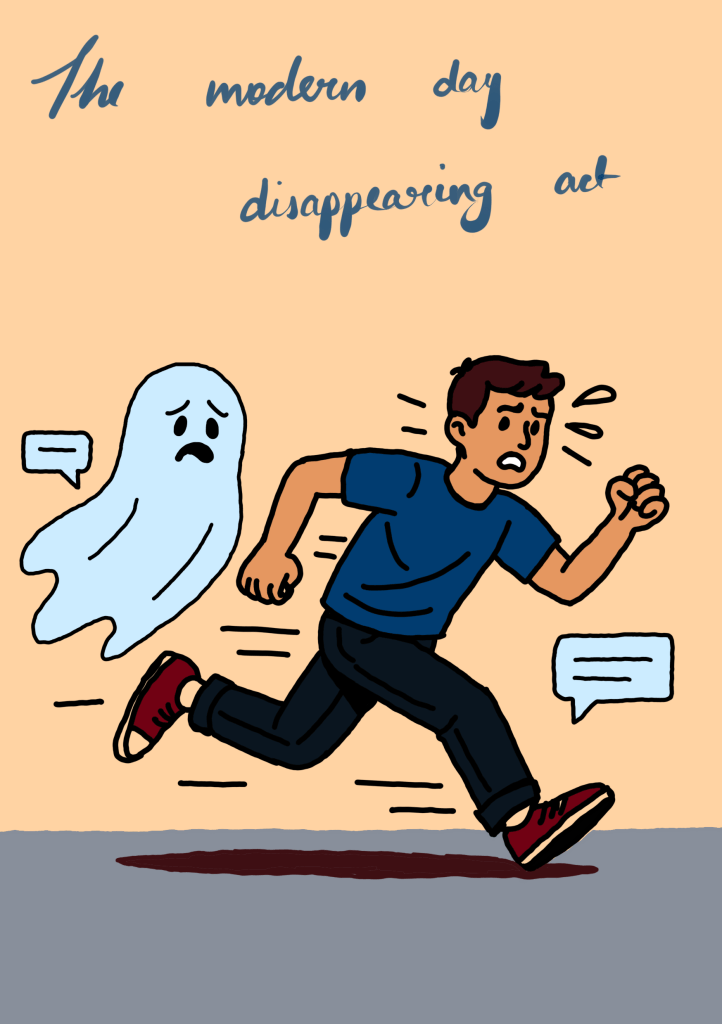
Running away from confrontation like it’s a stampede is the new side hobby of Gen
Z. Ghosting is one of those words, like love bombing, breadcrumbing, and
gaslighting, that are tossed in every conversation so often that it has lost all
meaning. Just because we’ve accepted disappearing without an explanation
doesn’t mean it stings any less when it happens.
Post-pandemic, the lack of emotional unavailability has grown stronger. Gen Z
adapted to life in isolation during lockdowns (attended school on Zoom calls,
without in-person interactions, Gen Z missed out on essential face-to-face
experiences like spontaneous bonding moments), with their social interactions
limited to screens. The outcome is a generation for whom solitude feels natural
and ignoring messages has become second nature.
Shubhi Saxena, a 22-year-old computer science engineering student from SRM
Institute of Science and T echnology, Chennai, doesn’t see the big deal.
“Whywould I give closure to someone I’ve never even met? If you connect with
someone online, great. If not, you move on. No one gets attached after texting for
three days.” Brutal? Yes. But in the world of disappearing acts, emotional
accountability is optional.
And for those on the receiving end? It’s not as easy to deal with. Nishchay
Khemka, a 21-year-old fashion design student from Pearl Academy, recalls the
one time he was ghosted.“I started questioning my self-worth. It made me feel
insecure for so long. Is closure too much effort?” In the age of hyper-connectivity,
people have never felt more replaceable.
The term ‘ghosting’ has become an excuse for poor behaviour. It’s easier to
disappear than to deal with discomfort, to treat conversations like a three-day free
trial that expires without notice. Aditi Asthana, a 20-year-old communication design
student from Pearl Academy, has a different perspective.“I move on pretty quickly.
When you meet someone online, you know it’s not real until you meet in person. It
doesn’t affect me.”
But when did this become acceptable? You can’t ghost a professor just because
you don’t want to deal with an assignment. Why, then, has it become second
nature in dating and friendships? The digital age has made people more
accessible than ever, yet responding to a message feels like a task.
Is ghosting a symptom of modern relationships, or have we stopped valuing
human connection? Perhaps both. Has ignoring someone’s existence become as
easy as scrolling past a post we don’t like?
 youfoundus